
Buddhism
A non-theistic philosophy of practical ethics and secular virtues — religious dogmas fixate on GOD; Buddhist teachings focus on YOU.
“If with a pure mind a person speaks or acts, happiness follows them like a never-departing shadow.” — Buddha, Dhammapada
“One of the greatest Sons of Light to ever appear to humanity is commonly called ‘The Buddha’… When His nearest disciples asked, ‘Great One, what are You?’ He simply replied: ‘I am… awake.’ He made no claims other than that His spiritual eye had been awakened to the ultimate unity of the One Mind.
Rather than form another religion filled with anthropomorphic deities and dogmatic beliefs, Buddha set out to create a living philosophy that would be free from the divisive tendencies and unprovable claims contained in many theologies. He stated that proof of His Teachings would come by way of productive personal experience to anyone willing to try the methods for themselves. Through the ages, many millions have come to agree with this approach. Religious dogmas fixate on GOD; Buddhist teachings focus on YOU.
Though the many expressions of Buddhism share much with other organized religions, Buddha's Teaching was offered to the world as something unique and complementary. Buddhism is neither an atheistic unfaith nor a theistic faith; it is a non-theistic philosophy of practical ethics and secular virtues.” — Business & Spirituality pp. 233–235
The Path to “Bliss-Nirvana”
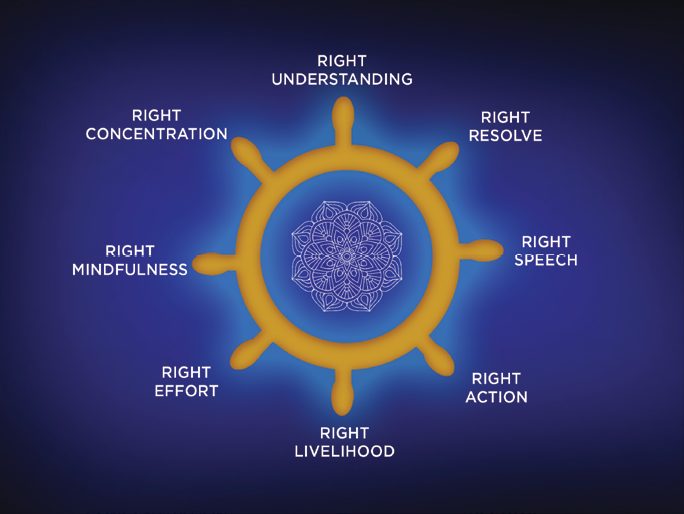
A System of Secular Ethics
Buddha’s teaching holds a unique credential among the world’s traditions: it asks for no belief at all. Try the methods, He said, and judge by results. Twenty-five centuries later, that experimental spirit makes Buddhism the tradition most at home in the modern, plural, professional world — as Business & Spirituality puts it, “a system of secular ethics” whose practices are “acceptable and non-threatening in a diverse group setting such as the modern corporation.”
At its heart lies a principle every overcommitted life recognizes the moment it hears it:
“The ideal is always found in the equilibrium, the Golden Mean, the Noble Middle Path. A balance of inner and outer goals, of spiritual and material values, will net maximal Triple Bottom Line profit.” — Justin S. Grant, MA, Business & Spirituality p. 71
The Middle Path is not compromise; it is precision — the string tuned neither slack nor snapping, the life neither numbed by indulgence nor brittle with denial. From that balance flow the practices the world now borrows daily from Buddha’s toolbox: mindfulness of breath, kindness deliberately cultivated, attention returned — gently, ten thousand times — to the present moment.
And the goal is not escape from the world but awakening within it. The bliss the tradition calls Nirvana is, in the unitive reading, the same summit every faith on this site names in its own tongue — reached here by the quietest road: sit down, breathe, and wake up.
“Lord Buddha's insight as to the need for a universal system of secular ethics rings true today as it did thousands of years ago.”Justin S. Grant, MA · Business & Spirituality p. 247
Hear the Buddhist version of The Great Invocation — free audio, twenty-four versions, one world prayer.